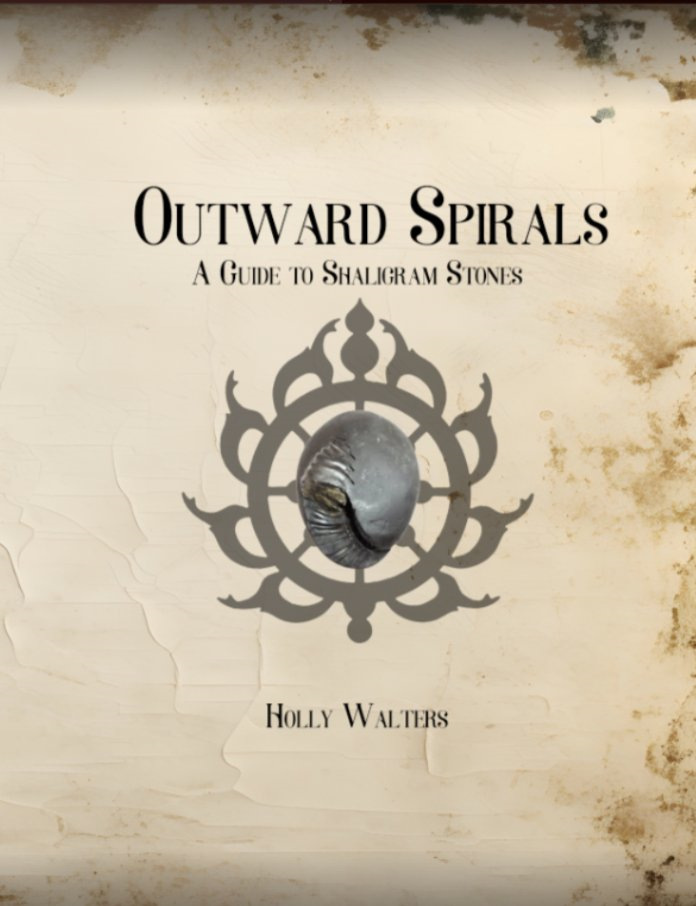
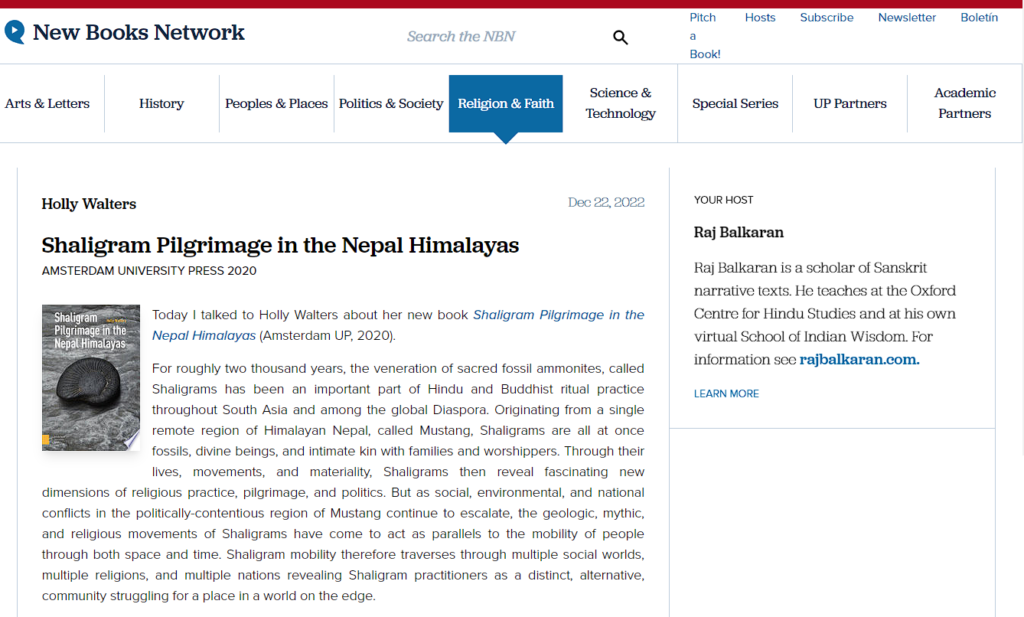
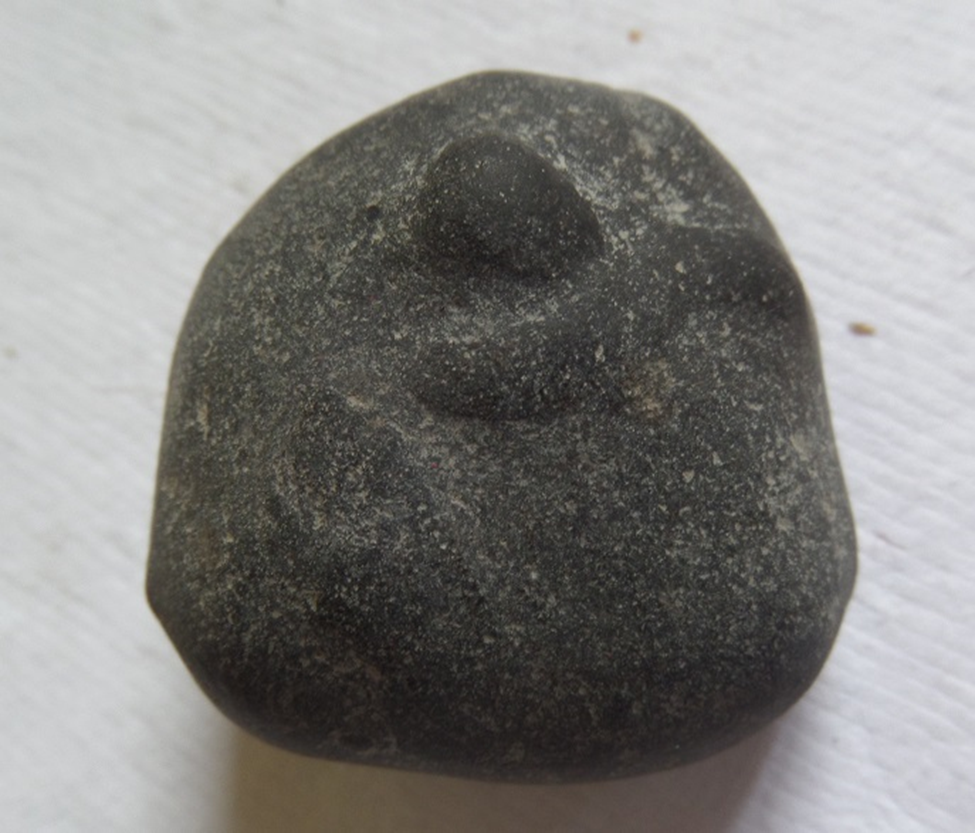
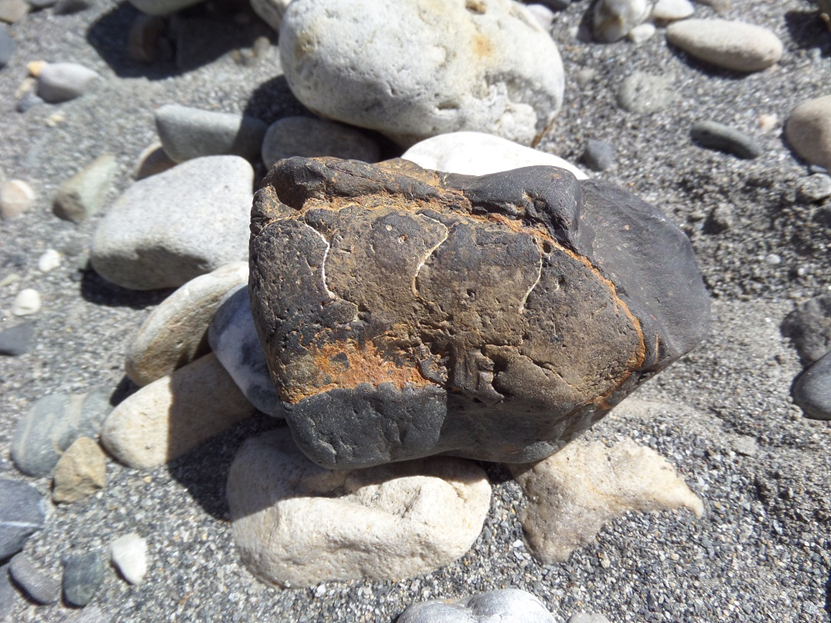
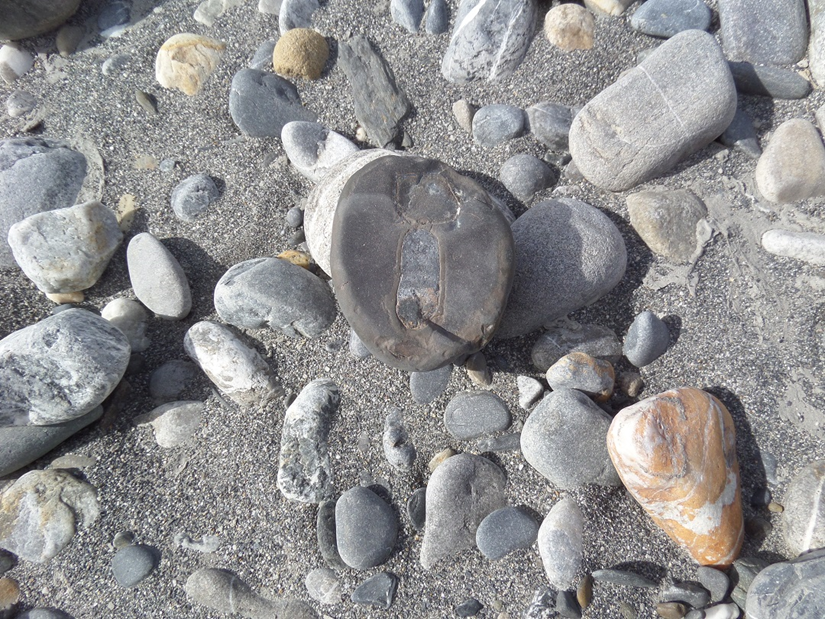
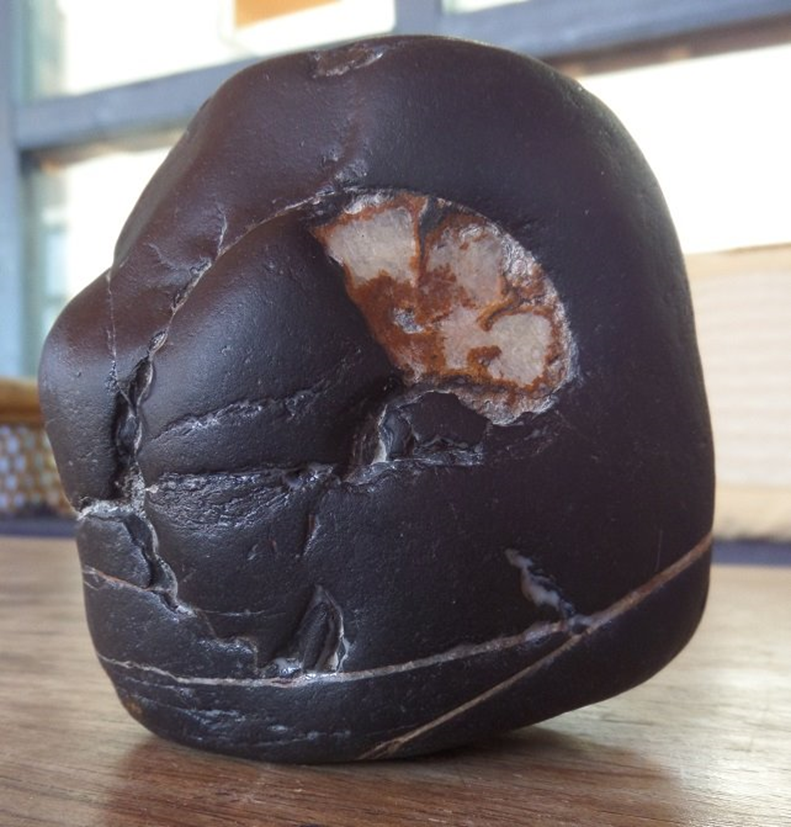
12 years in the making and my guide to Shaligram interpretive traditions has finally been published! It’s available from TLS Press on all platforms where books are sold!
I am truly proud of this work and want to thank all those who made it possible. From the Shaligram pilgrims and devotees and I met and worked with over these many years, to my Nepali friends and colleagues in Mustang. This book represents not just several years of ethnographic fieldwork in the Kali Gandaki valley but continuous research before and after as I met with temple congregations, Hindu and Buddhist communities in and out of South Asia, and ritual specialists from all over the world.
So, here it is and I am sending all of the knowledge I recorded back to you!
(This text is currently only available in English, though I am seeking opportunities to have it translated into Hindi and Nepali. It does, however, contain complete full-color photographs of each Shaligram type as well as a description of how that shila is read drawn from both Puranic texts and from local practices. Enjoy!)
As this blog has grown, I have been getting more and more requests to identify or verify Shaligram stones; to make a determination of their manifestation or their authenticity. This is something I have always been happy to help with. However, the number of requests has grown to such a degree where I have to formalize my policy.
My policy on performing this service is:
I will identify or verify one or two Shaligrams for free. It takes about 10-15 minutes per shila to make a full evaluation and I am happy to answer questions when I can.
If you would like me to identify more than two Shaligrams, I ask for $5 (US) per identification to cover time and the textual work involved.(Up to 10 shilas).
If you would like me to identify more than 10 Shaligrams, we can discuss the amount of time the collection is likely to take and negotiate accordingly.
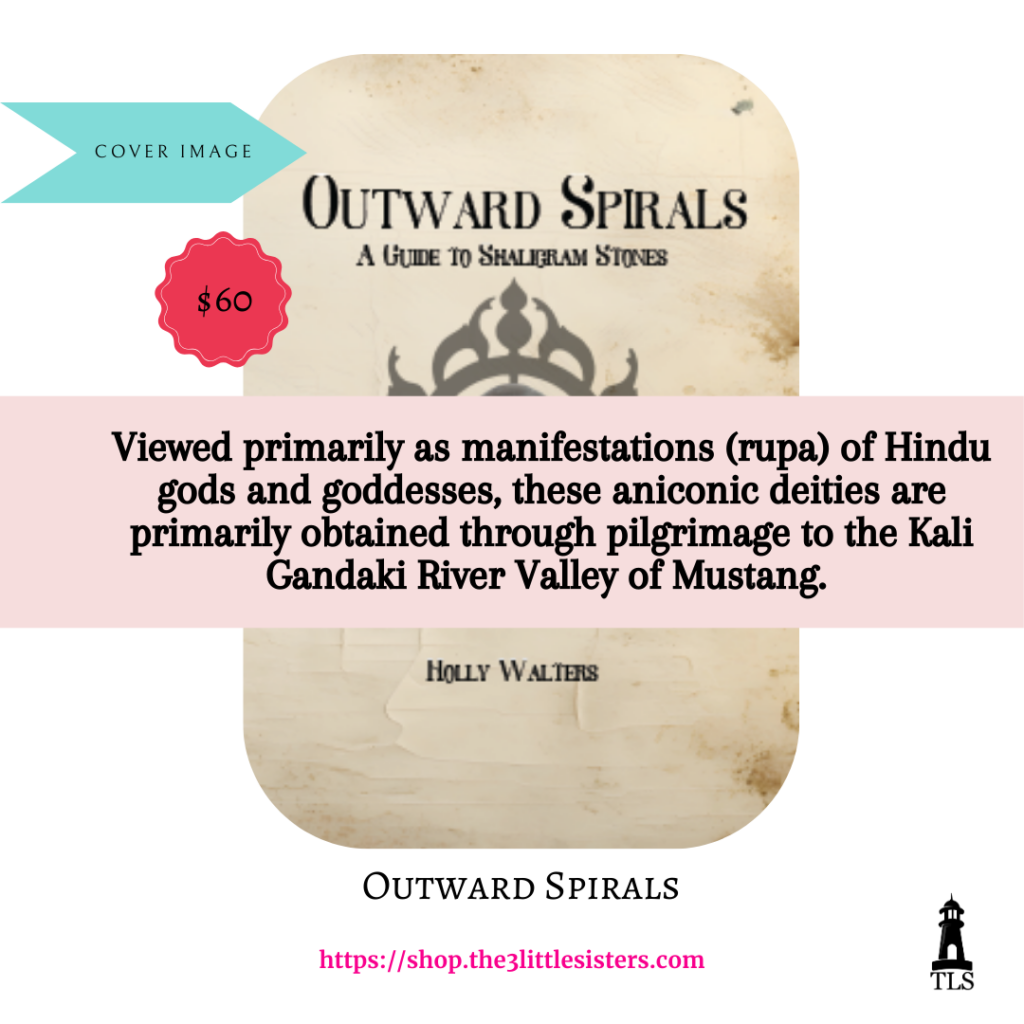
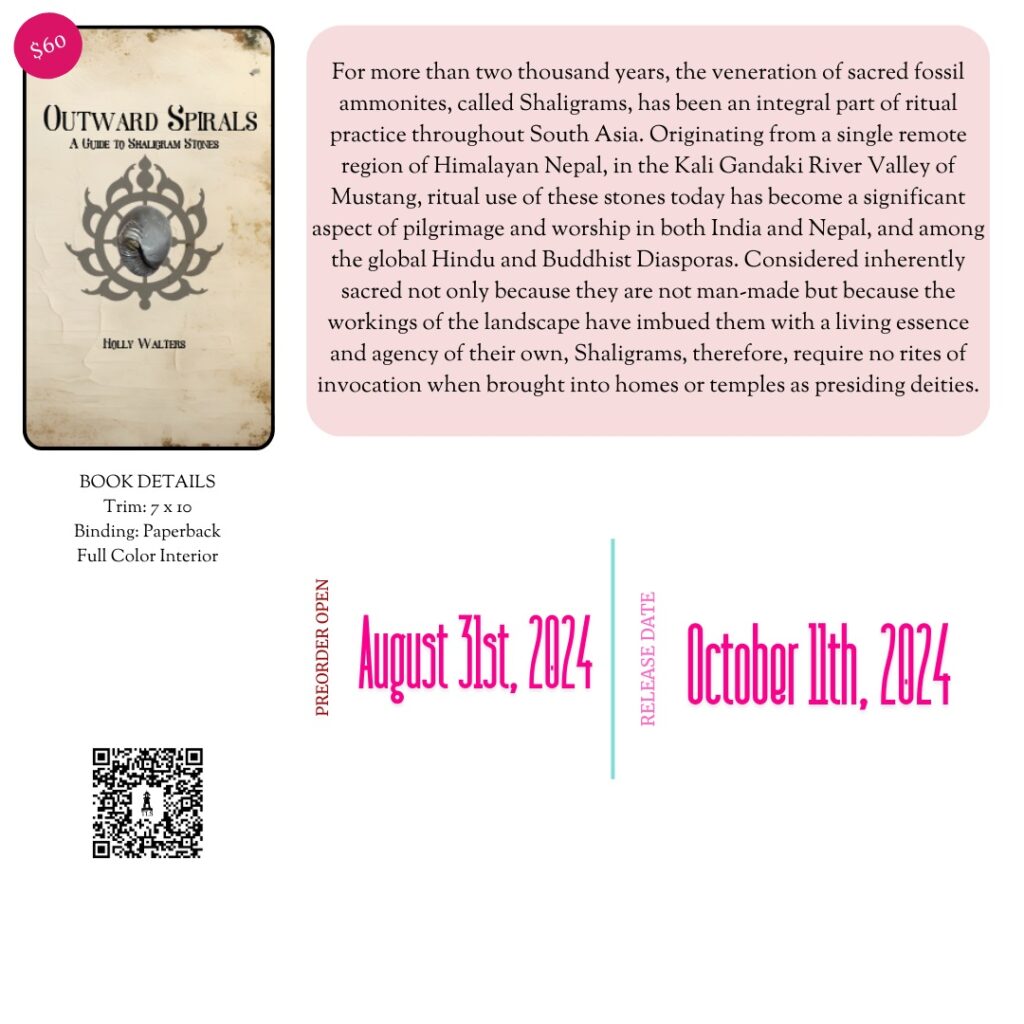
I am so incredibly pleased to announce that Outward Spirals: A Guide to Shaligram Stones is now available for pre-order!
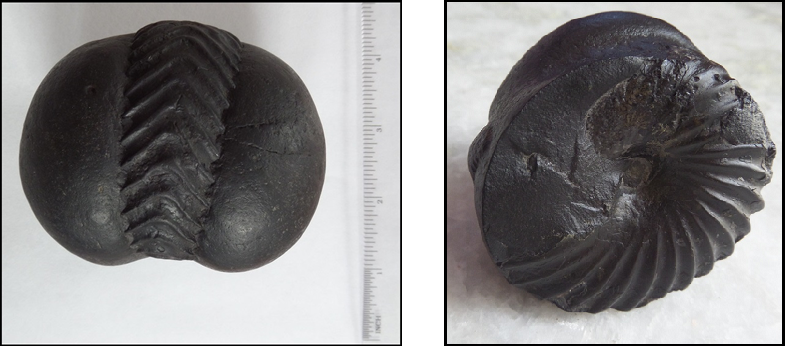
This book is the culmination of my ethnographic work with Shaligrams and Shaligram devotee communities over the last 12 years. It contains a general discussion of Shaligrams and where they come from, descriptions of four different kinds of Shaligram pujas, a re-printing of the ShaligramStotram (Shaligram worship recitation in Sanskrit), and over 90 full-color photographs of each type of Shaligram rupa (form/manifestation) and bhava (mood).
I am especially proud of the last part. It took me more than three years to find a publisher willing to print this work in the way I knew it needed to be done. Because this book is designed for the public and for all those who want to learn more about the Shaligrams in their lives, I wanted to do something no other Shaligram scholar has ever been able to do. Print a guide to Shaligram interpretive traditions with real photos and images of each Shaligram type, so that readers can see exactly what the Puranic and Tantric texts are describing.
For that reason, this book is for Shaligram devotees who are interested in what their traditions look like all over the world (from India and Nepal to Australia and the United States), it’s for Hindus and Buddhists searching for more comprehensive information about Shaligram interpretation, and it’s for the lay public who might simply want to know more about this incredible spiritual practice.
All my thanks to TLS Press for being as enthusiastic about making this happen as I am! I hope this book is as exciting to you as it is to me.
The time is finally (FINALLY!) upon us! Outward Spirals, the guide to Shaligram interpretive traditions, will go on pre-order from TLS Press starting August 31st! As soon as the link is available, I will post it here for anyone interested in getting a copy as soon as it is released on October 11th!
This marks almost 4 years to the day that I published my first book on Shaligram practices, Shaligram Pilgrimage in the the Nepal Himalayas (AUP, 2020) but this book is written both for the public and for Shaligram practitioners who would like to learn more about the specific methods of reading Shaligram stones.
Stay tuned because there is definitely more to come!
I have been noticing that with the last few updates and patches that WordPress has gone through, some of the text in my older posts in slowly getting corrupted. I apologize for this. But unless I am able to spend a week going through each and every post to fix all the character and letter mistakes, there is little I can do about it right now.
I will try and start cleaning some of them up over the next few months but bear with me. And know that I am aware of the problem and have certainly not abandoned the site.
It’s taken over a decade of work to get here but Outward Spirals finally has a release date for October, 2024.
When I met my first Shaligram on the way to India in 2012, I never could have imagined this would be the result. I will definitely have more to say the closer we get to pre-orders, but let this be welcoming news for the new year.
I finally have some good news to share about the Shaligram interpretive guide that I know so many of you have been asking me about for the past few years. Well, we finally have a release date!
March 2024.
The book manuscript currently covers 90 Shaligram name-types with several of their variations and Puranic references. This means that I have documented most of the primary types of Shaligrams identified by multiple religious traditions and their most common appearances. But, it is important to remember that I certainly haven’t been able to cover ever possible variation or manifestation (which I talk about in the introduction). However, I sincerely hope that this book will allow me to give back to so many Shaligram practitioners, devotees, and communities who have helped me in my research over the past ten years.
It’s hard to believe that I have dedicated a decade to learning Shaligram interpretive traditions. I’ve lived in India for a time and spent over two years in Mustang, Nepal focusing on the Kali Gandaki pilgrimage route specifically. Along the way, I have had the distinct pleasure and privilege to meet and work with gurus, sadhus, ritual specialists, and devotees from all over the world. It is my hope that this book reflects all of that accumulated knowledge and makes it accessible to anyone and everyone who wants it.
I will, of course, talk about the book more as we close in on the release, but I wanted to thank you all for your help and support of this work. It will be a happy day when the book, with photos and drawings all included, is finally out in the world.
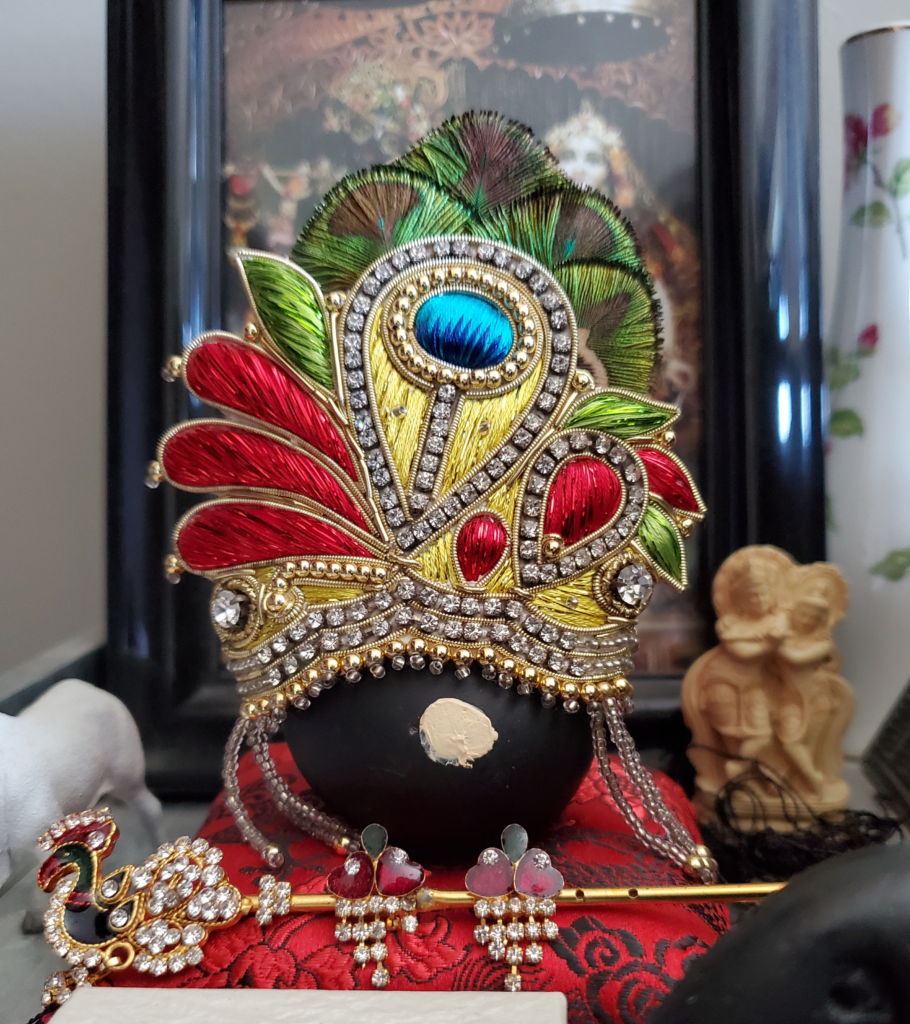
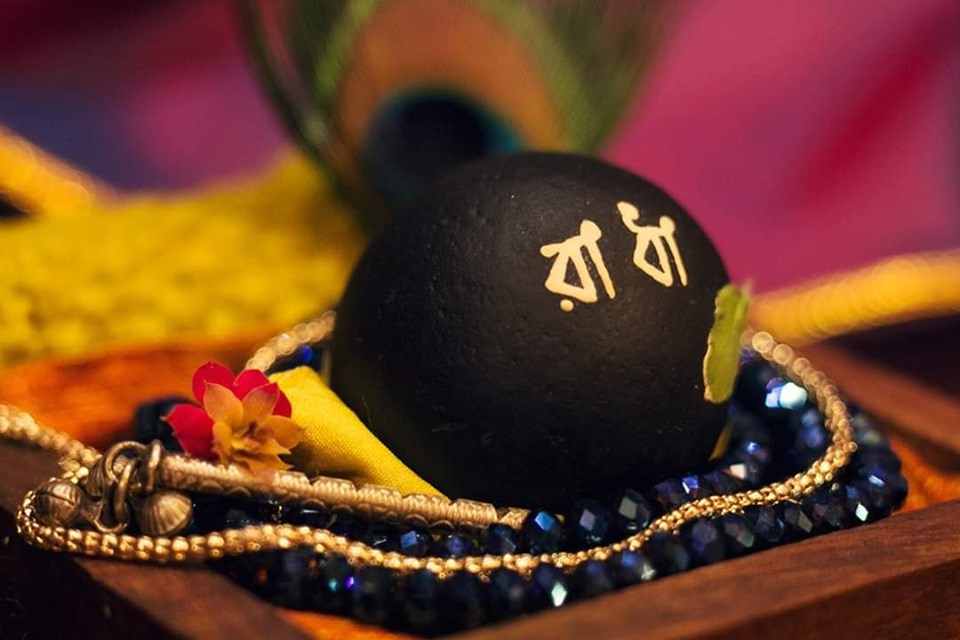
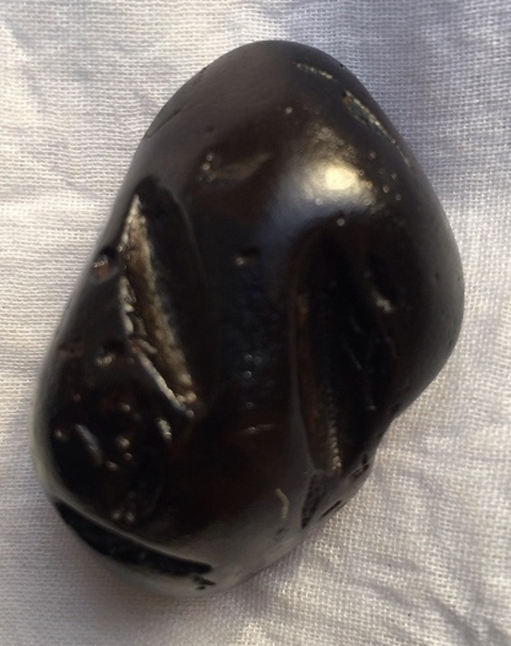
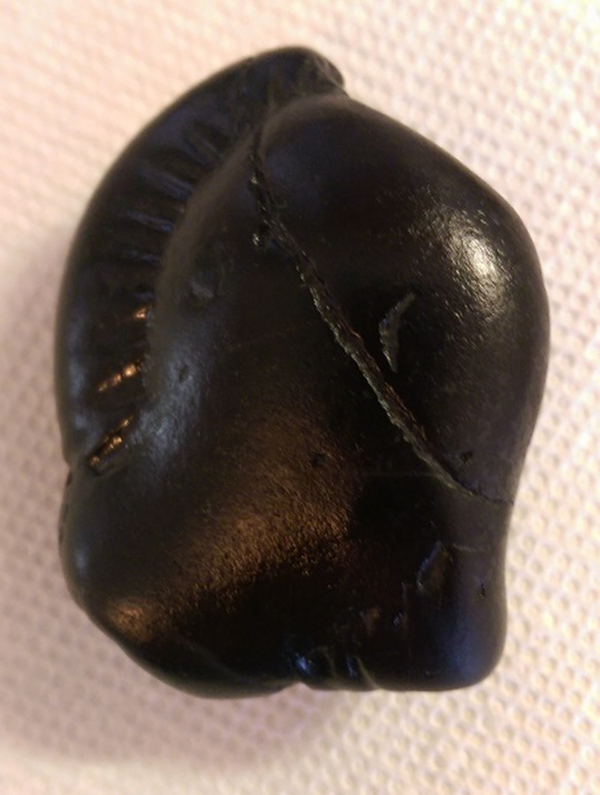
A Krishna Gopala Shaligram from the author’s personal collection.
I’ve been hard at work recently with the new book on Shaligram interpretive tradition which is still on track to come out around the end of 2023. But, in the meantime, I spent some time with Dr. Raj Balkaran talking about my first book and my fieldwork in Nepal on Shaligram pilgrimage.
If you want to hear me talk more about my work, check it out!
I’ve been hard at work editing the manuscript for my upcoming book on Shaligram interpretive traditions and I am excited that we are still on track for publication next year. As I continue with the additions and changes however, I want to share my current table of contents. While I do have a page limit (to ensure that the book can be printed affordably), I have added some Shaligrams that I wasn’t able to before, bringing me to a name-list of 85. I still have some leeway to work with though. As such, let me know if there are any Shaligrams I haven’t included here that you might like to see added to the discussion!
(Note: I am not including multiple manifestations — meaning Shaligrams that have more than one deity appearing in their characteristics. This guide specifically focuses on single name-types.)
My second manuscript, designed for a popular general audience, finally has a publisher! I can hardly believe it but the book will be coming out in 2023!
I have planned a guide that details each type of Shaligram with photographs and line drawings explaining exactly how each shila is identified and what characteristics mean what.
Stay tuned for more information as I work on revisions and updates!
–HW
All thanks and praises to Shaligram shila for this blessing!
One of the most complicated aspects of Shaligram interpretation, and the one that often takes the longest to learn, is reading the various small markings that indicate the nuances of a specific manifestation. While I have already posted extensively on the major aspects of interpretation (i.e., set, color, chakra, vadana, vanamala, and so on), I haven’t yet truly tackled a discussion of secondary markings. To be honest, it’s an intimidating topic; not just because it’s complicated in practice but also because there really is no overarching standard to reference in terms of how this kind of Shaligram reading is done. That being said, there are some typical features that appear in the Puranic texts that make for a reasonably easy introduction to the basics. As such, my caveat here is one I’ve made before. I will cover the broad strokes of this kind of Shaligram interpretation while also continually noting that this is by no means comprehensive and you will likely encounter even more detail and variable techniques depending on the specific Shaligram tradition you consult.
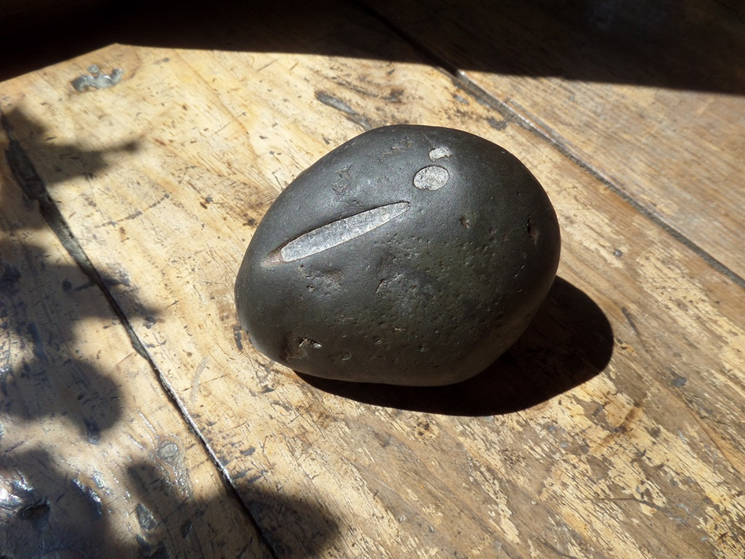
The issue of small or minute markings is one that appears commonly in scriptural Shaligram descriptions. Usually referred to as “circular marks,” “linear marks,” “marks of a conch,” or “weapon marks,” these surface details that may or may not appear on a particular Shaligram act as guides to the specific mood (bhava) of the deity present or as indications of a unique manifestation (such as the difference between a Krishna Govinda Shaligram and a Krishna Gopala Shaligram). For this reason, any given Shaligram may have one, many, or no markings at all that can add varying levels of complexity to its interpretation. For example, the typical Sri Ram Shaligram is described as having a single outer chakra with a white vanamala that goes all the way around the shila. But Sri Ram also appears in secondary markings. Specifically, the “arrow” marking (the long white line shown below).
Sri Ram Shaligram with white arrow marking
The “arrow” marking can also appear like this:
Sri Ram Shaligram with black “arrow” marking
In both cases, the “arrow” is described as a long line, raised or depressed into the stone, with a corresponding round “heel” mark somewhere next to it.
Other common markings include the icons of various weapons, such as the Gada (mace) or Shiva’s Trishula (trident).
Shaligram with trishula markingShaligram with gada marking
The appearance of weapons on a Shaligram tends to denote that the bhava (mood) of the deity present is highly protective or, in some cases, even hostile (depending on the deity). These Shaligrams tend to be viewed with a measure of caution then, until the exact nature of the manifestation can be determined. They are not uncommon in households though and many devotees seek them out in times of hardship or when misfortune has befallen them or their loved ones.
There is also, of course, the popular Padma or lotus marking, which is almost the exact polar opposite of the weapon marking because it indicates a Shaligram in a state of calm or meditation. Here it is on a Madhusudana Shaligram that also contains a white vanamala (garland) marking around the base.
Madhusudana Shaligram with padma marking and vanamala
Lotus markings, however, can appear in a few different ways. In the four Mahavishnu Shaligrams pictured below, the lotus appears on the front of the top right shila.
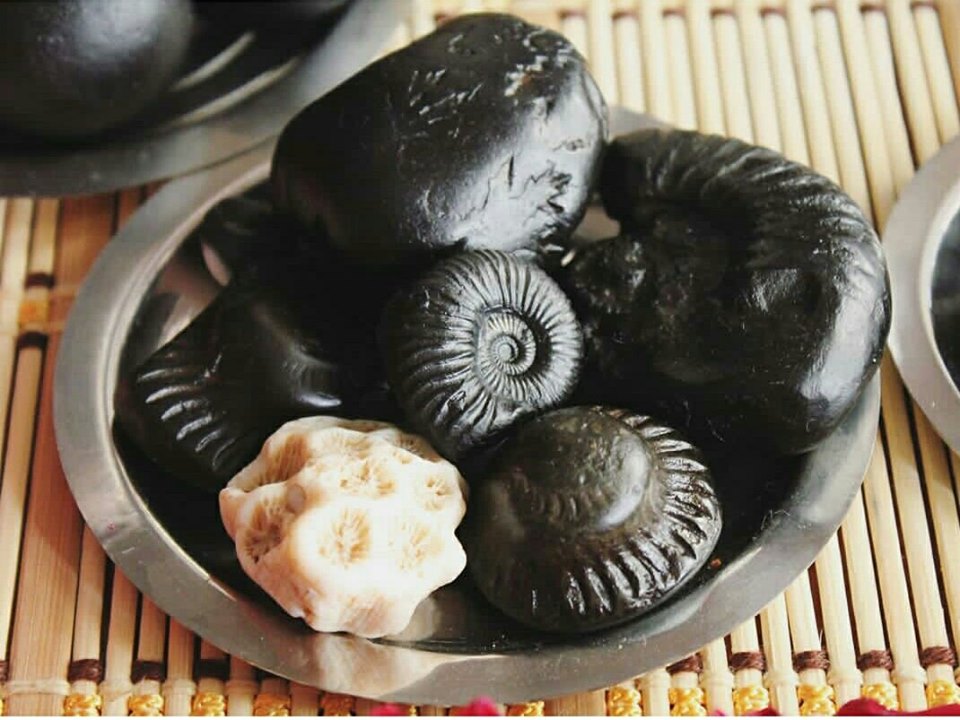
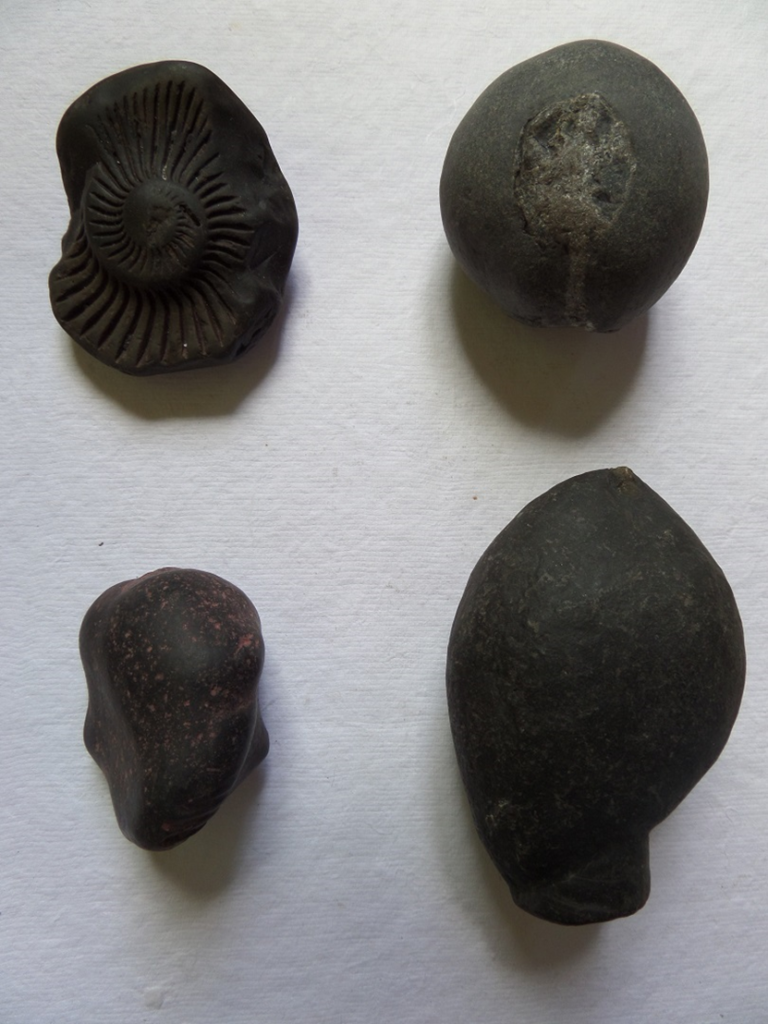
These four Shaligrams then comprise a puja set (from top left: Sudarshan Shaligram, Padma Shaligram, Shankha Shaligram, Gada Shaligram).
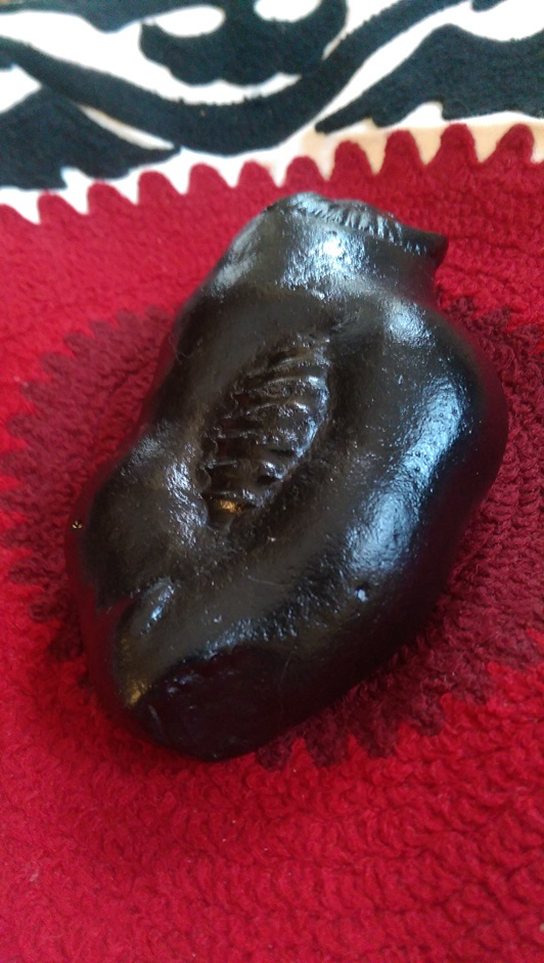
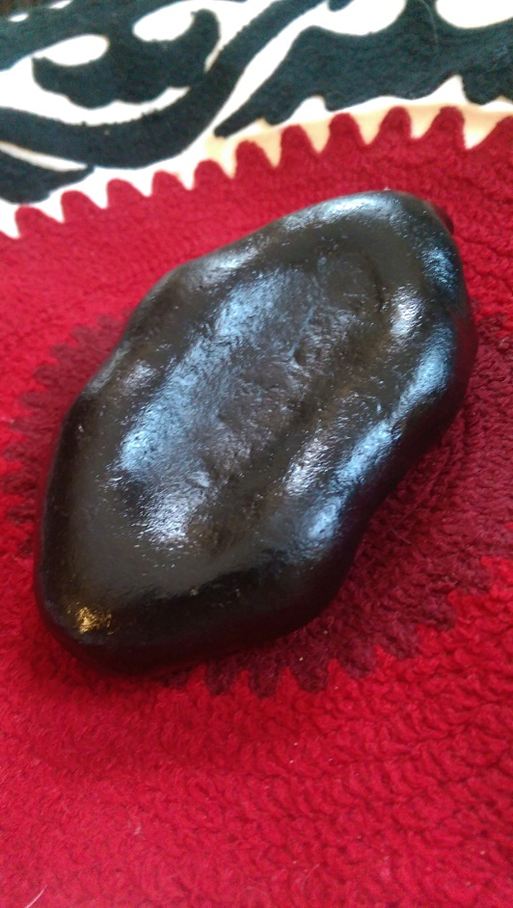
Secondary markings can also be far more subtle than this. The Mahavishnu Multi-Chakra Shaligram that follows after here has a deep elongated depression on its underside. The presence of this flattened “bowl” shape indicates that this Shaligram is a Yagnamurti and can be used for community rites.
Top of MahavishnuBottom of Mahavishnu
Yagnamurti Shaligrams also commonly have the markings of sruk and sruva, the two spoons or “sticks” used in fire rituals. In all, these characteristics can appear alone or together and can be found on all manner of Shaligrams.
Sruk and Sruva on a Krishna Shaligram
One of the most challenging aspects for me, in learning Shaligram interpretation, has always been the difference between “linear marks” and vanamala. While vanamala markings are almost always white and therefore differentiated on the basis of size and color, linear marks can still look very similar. This Parashurama Shaligram, for example, has one such ambiguous marking.
Parashurama Shaligram
As you can see, the linear mark is quite deep and readily observable in the stone. It even goes all the way around the top of the Shaligram, again, in much the same way as a vanamala would. So, which is it then? A vanamala or a “linear mark?” Ultimately, in this case, the final determination is made using the Shaligram’s other characteristics. The shape of this stone is called “axe-like,” with a longer chakra ridge on one side of the shila and a shorter ridge opposite it. The rounded central body and smooth features then indicate that this is Parashurama and since it is Parashurama (Sanskrit: “Rama with an axe,” the sixth incarnation of the Dasavatara), the marking is that of his sacred thread. This variation of Parashurama is then that of the warrior who has surrendered his weapons and taken up his role as Guru.
And finally, there is similar complexity between chakras (the spiral discus formation) and “circular marks.” This one is slightly easier to determine though. Chakras are pretty distinctive in that they are spiral formations with ridges along their surface.
Sudarshan Shaligram
Circular marks are much smaller and don’t have much in the way of identifiable features.
Vishvarupa Shaligram
The presence of linear and circular marks must then be taken into consideration when reading the overall Shaligram since linear marks tends to indicate a more passive, instructive, or contemplative deity while circular marks tend to indicate a larger, more cosmic, form of the deity.
Ultimately, reading Shaligrams is a lengthy and complicated process that involves extensive knowledge of ritual traditions, stories, and histories. Etched on the face of every Shaligram is an entire text, only available to those who know how to speak its language and understand its script. But this is also how Shaligram connects the past, the present, and the future: by carrying within itself the entirety of a world that stretches backwards and forwards into indeterminate eons. This is how every Shaligram tells a story. Unfortunately, there are, without a doubt, volumes I could write on each and every specific manifestation and all of the possible markings that might appear on a given Shaligram, but alas, I only have so much time myself.